

Workshop on Automated Control Systems for Flexible Heat and Power
A sustainable energy supply requires a flexible, robust, and cross-sectoral energy system that fully utilizes the specific advantages of different renewable energy technologies. To achieve this, controllable technologies must reliably compensate for the variability of non-controllable renewable sources. Appropriate control strategies for both real-time and forward-looking flexible operation are therefore essential.
As part of the Central European Biomass Conference 2026 in Graz, IEA Bioenergy Task 44 Flexible Bioenergy and System Integration organized a special session dedicated to the control and automation challenges involved in providing flexibility through bioenergy technologies for the heating and electricity sectors. The event was open to all interested participants and attracted more than 50 attendees.
The workshop featured an introductory presentation on the technical possibilities of flexible bioenergy technologies and systems, followed by an overview of electricity markets, tariffs, and support schemes for flexibility provision. Industry presentations provided practical examples and business models for flexibility services. By bringing together researchers, technology providers, and end users, the workshop facilitated a holistic discussion on the opportunities and challenges of flexible bioenergy systems.
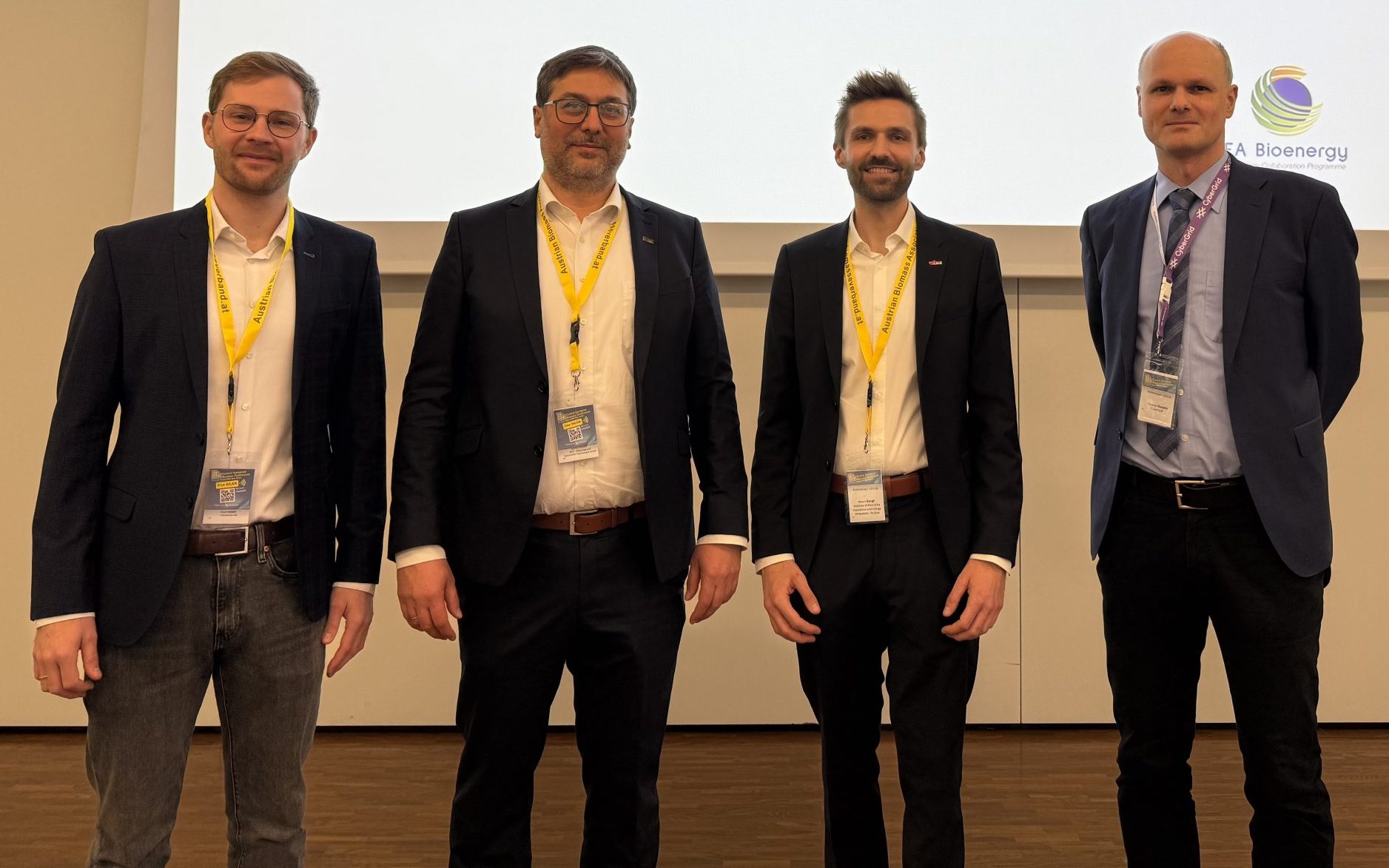
Speakers from left to right: David Huber (oekostrom AG, Austria), Markus Gölles (BEST, Austria), Robert Gaugl (Institute of Electricity Economics and Energy Innovation – TU Graz, Austria), Christoph Gutschi (CyberGrid, Austria)
Agenda
Chair: Markus Gölles, BEST – Bioenergy and Sustainable Technologies, Austria
Opening and Technical Possibilities of Flexible Bioenergy Technologies and Systems
Markus Gölles, BEST – Bioenergy and Sustainable Technologies, Austria
Presentation of Task 44 activities on automation and control strategies for flexible bioenergy systems in the heat and power sectors. The focus was on software applications suitable for residential buildings, energy communities, solar thermal systems, district heating networks, commercial facilities, and industry. Flexibility optimization is required both at the technology level through advanced control systems and at the system level through the scheduling of controllable producers, storage units, and consumers.
Electricity Markets, Tariffs and Supporting Schemes for Flexibility Provision: An Overview
Robert Gaugl, Institute of Electricity Economics and Energy Innovation, TU Graz, Austria
Overview of Austria’s practical “routes to market” for flexibility services. Flexibility can be monetized through two main value streams: (a) trading value, achieved by shifting generation to higher-price periods and avoiding negative-price situations or curtailment, and (b) balancing market value, gained by making reserve capacity available, often via aggregators. A decision matrix summarized the characteristics of market premiums, dynamic feed-in tariffs, virtual power plants (portfolio optimization), and balancing energy markets.
Unlocking Flexibility Value through Variable Feed-In Tariffs
David Huber, oekostrom AG, Austria
Presentation of a cloud-based optimization solution for supply-side and demand-side management that translates tariffs and market prices into asset dispatch plans. A hydropower case study demonstrated an 8.3% increase in spot-market revenues while maintaining the same amount of energy sold. Reliable metering and availability signals were identified as key value drivers, while realistic operational constraints ensure feasible dispatch schedules. Transparency, operator override functions, and clearly defined responsibilities were highlighted as important factors for successful implementation.
Monetizing Bioenergy Asset Flexibility in Balancing Markets
Christoph Gutschi, CyberGrid, Austria
Presentation of a fully automated software solution for continuous, 24/7 participation in multiple electricity markets. The platform manages ancillary service capacity bidding, day-ahead market participation, intraday trading, and ancillary service energy bidding. The option for manual intervention supports operators during the transition towards fully automated market participation. The service is available for industrial and utility-scale applications.
Interactive Discussion
The session concluded with an interactive discussion between the audience and presenters.
All presentations are available here: CEBC 2026 – IEAB Task 44 WS Flexibility
Main Conclusions
- Current control strategies are generally not designed for highly flexible operation. However, research and development activities on advanced control systems for biomass technologies demonstrate that appropriately controlled biomass conversion systems can provide substantial flexibility across a wide range of applications.
- Biomass conversion technologies are often integrated into broader multi-energy systems. Achieving optimal system operation therefore requires coordinated scheduling and control of all relevant technologies.
- Flexibility can be provided to the electricity sector directly through combined heat and power (CHP) plants, but also indirectly by increasing the operational flexibility of other technologies, such as heat pumps, through flexible heat supply from hybrid biomass systems.
- There are numerous opportunities for participation in flexibility markets, including dynamic pricing schemes, intraday electricity trading, balancing and ancillary service markets, and combinations of these approaches. The most suitable participation strategy depends strongly on system-specific boundary conditions and currently requires case-by-case assessment.
- Regulatory frameworks, market designs, and technical requirements for flexibility provision differ significantly between countries. Participants therefore identified a strong need for standardized approaches.
- The need for standardization is further reinforced by the fact that technical implementations currently require extensive customization across technologies, applications, and flexibility providers such as aggregators, resulting in increased implementation costs.
- The value of flexibility services depends strongly on reliability, including the ability to meet bidding commitments and operational schedules. This requires advanced, robust, and highly reliable control strategies.
Main Measures to Be Taken
- Increase awareness of the flexibility potential offered by biomass technologies and systems.
- Promote the standardization of interfaces and methods for assessing different technological solutions.
- Continue research and development on advanced control and automation strategies at both the system and technology levels.