
IEA Bioenergy Inter-Task Project Synergies of Green Hydrogen and Biobased Value Chains
The objective of the Inter-task project is to identify and assess synergies in the deployment of green hydrogen and bio-based value chains that can enhance the use of both energy carriers and the energy system under different conditions. Economics, sustainability, and infrastructural topics are addressed through Case Studies in order to increase visibility and knowledge of the promising solutions. The project aims at providing a synthesized view on promising value chains, major drivers and barriers for the deployment, and measures to overcome the barriers.
Duration: June 2022 – December 2024
Participating IEA Bioenergy Tasks: 32, 33, 34, 36, 37, 39, 40, 42, 44, 45, Collaboration with the Hydrogen TCP
Project leads: Christiane Hennig and Tiia Kanto
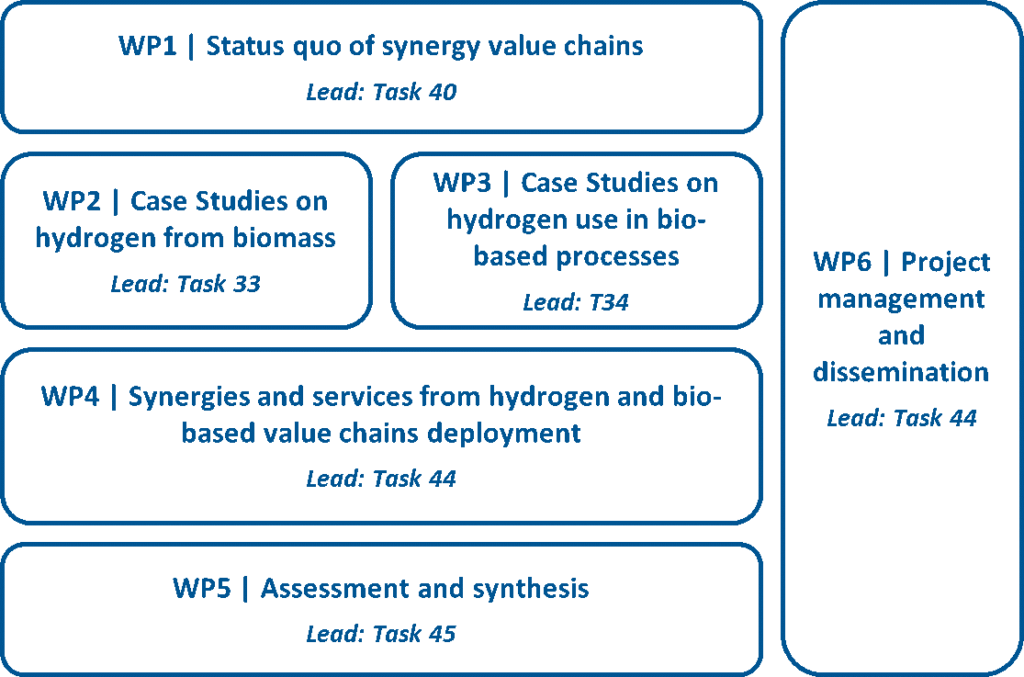
Work Packages
Dissemination and Events
Expert Workshop “Biomass and Hydrogen – Allies for Net Zero” organized by IEA Bioenergy TCP jointly with the Hydrogen TCP at IEA HQ in Paris”
15 May 2025
Sustainable fuels such as biofuels and hydrogen will play an important role in clean energy transitions. They complement direct electrification and energy efficiency measures in reducing emissions in sectors that are hard to abate, while providing energy diversification, security, and economic development opportunities.
What is less known, however, that interesting synergies emerge when bioenergy and renewable hydrogen are developed in a more integrated manner. Such opportunities were explored in depth in the Workshop “Biomass and Hydrogen – Allies for Net Zero”, that took place on 15 May at IEA HQ in Paris. It was organised by the IEA Hydrogen Technology Collaboration Programme and the IEA Bioenergy Technology Collaboration Programme, and supported by the International Energy Agency. Workshop presentations, panel discussions and moderations were supported from IEA Bioenergy Task 44, IEA Bioenergy Task 33, IEA Bioenergy Task 34, IEA Bioenergy Task 40 and IEA Bioenergy Task 45.
In this workshop, presenters touched upon these integration options and their synergies, addressing opportunities and challenges, including environmental, socio-economic and regulatory aspects beyond the technological aspects. Following the presentations, panel discussions were organised to allow for interaction between speakers and participants of the Workshop as to discuss the role of biohydrogen and combinations of hydrogen and biogenic carbon within the future energy system, how to realize identified synergies and to understand what next steps are needed to accelerate these developments. The workshop brought together researchers, technology providers, policy makers and industry players and investors.
Further information are available here.
IEA Bioenergy Webinar “Synergies of renewable hydrogen and biobased value chains deployment: environmental performance and promising value chains”
6 May 2025

This webinar is part of a webinar series within the IEA Bioenergy Inter-task project Synergies of green hydrogen and bio-based value chains deployment. While the first webinar presented the status of technologies and highlighted selected case studies, this webinar covers the assessment of promising (synergy) value chains. This webinar highlights joint contributions from IEA Bioenergy Task 44, IEA Bioenergy Task 45 and IEA Bioenergy Task 40. The presentations and the recording of the webinar can be accessed via the following links.
DOWNLOAD THE PRESENTATIONS:
- Christiane Hennig – Synergies of renewable hydrogen and biobased value chains deployment
- Richard Kingsley Padi – Synergizing Biofuels and Electrolytic Hydrogen: Environmental Insights
- Andres Martinez Arce – Life cycle assessment of two novel biohydrogen value chain configurations based on anaerobic digestion
IEA Bioenergy Webinar “Synergies of renewable hydrogen and biobased value chains deployment: case studies”
26 September 2024
 Producing biobased hydrogen could be an alternative option for renewable hydrogen provision. Moreover, there are many biobased processes either high in demand for renewable hydrogen (e.g. synthetic renewable fuels, biorefining) or that could benefit from renewable hydrogen integration. This webinar attempts to shed light on promising biobased value chains that could deploy synergies between the hydrogen economy and the biobased economy by focusing on recent concepts for
- Hydrogen production from biomass
- Use of renewable hydrogen in biobased processes, considered in different parts of the world
This IEA Bioenergy free webinar presents case studies as tools to assess the synergies of renewable hydrogen and biobased value chains and highlights joint contributions from IEA Bioenergy Task 44, IEA Bioenergy Task 33 and IEA Bioenergy Task 34.
DOWNLOAD THE PRESENTATIONS:
- Christiane Hennig – Introduction
- Axel Funke – Case studies on hydrogen use in bio-based processes
- Joakim Lundgren – Case studies on biomass-based hydrogen production
- Laura Rahikka – Hycamite
- Utsav Vikram Dutta – Creating value by utilization of renewable H₂ in biobased processes
Expert workshop ‘Deployment perspective of green hydrogen from biomass and green hydrogen use in bio-based processes’, Berlin/hybrid
29 March 2023
The expert workshop was organized by IEA Bioenergy Task 40, Work Package 1 leader, in collaboration with 9 other IEA Bioenergy Tasks as a Work Package 1 deliverable. Experts from IEA Bioenergy, Hydrogen and AMF TCPs, academia, industry presented overview on synergies of green hydrogen and bio-based value chains from different perspectives, introduced a set of specific case studies, and discussed the assessment framework of case studies.
The presentations are available here.
A Scoping Report with a workshop summary is available here.
Publications
12 November 2025
“Synthesis Report: Synergies of green hydrogen and biobased value chains deployment”

This report summarizes the assessment work done for different case studies on the production of hydrogen from biomass or the renewable hydrogen uptake in biobased processes. Different services provided from hydrogen and biobased value chains deployment as perceived in energy system modelling are presented. A thourough overview on the environmental performance of the different case studies including the description of the Life Cycle Assessment methodology developed for considering the environmental impact of hydrogen use in biobased value chains. We provide a concise presentation of the overall results and put these into a broader context and discuss further research needs.
A group of experts from the IEA Bioenergy Tasks 44, 45, 40, 33 and 34 have compiled this work as outcome of the Work Packages 4 and 5 of the ITP Synergies. The activity has been coordinated by Task 44 with Christiane Hennig.
Our newest publication is here!
5 December 2025
“WP3 Report: Synergies and Services from H2 and Biobased Value Chains Deployment | Case studies”

In this report, we provide an overview of ten prominent case studies from around the world that explore the potential use of renewable hydrogen in biobased value chains. These case studies form the core of the analysis, illustrating diverse technological pathways, economic and climate implications, and possible roles within the broader energy system. They highlight key advantages, including the integration of methanation or other PtX processes without the need for separate CO₂ capture—thereby reducing CAPEX and OPEX—and the benefit of higher CO₂ concentrations in biogenic offgases. Together, the case studies offer a concise picture of current projects investigating synergies between hydrogen and biomass deployment, and they place these findings in a wider context of technological readiness and economic performance. Finally, the report outlines remaining research needs to support the realization and scaling of such projects.
A group of experts from IEA Bioenergy Tasks 34, 32, 33, 37, 39, 42 and 44 contributed to this work as part of Work Package 3 of the ITP Synergies, which was coordinated by Axel Funke (Task 34, KIT, Germany).
22 August 2025
“WP2 Report: Case studies on hydrogen produced from biomass”

The report looks into types of technologies for producing biomass-based hydrogen (so-called biohydrogen) and their respective technology readiness level. It provides a synthesized view on promising biomass technologies and the major drivers and barriers for their deployment. The descriptions of technologies and concepts – including 1) technology readiness and economic fundamentals and 2) climate effects and role in the energy system – are done through case studies.
This report shows that renewable, biomass-based hydrogen can be produced via several different conversion technologies, from a variety of biogenic feedstocks and in a wide capacity range. Feedstocks can be of
- Lower grades, such as wastewater, forestry and agricultural residues, which may improve the economic performance of a plant.
- Higher quality feedstock such as bioethanol and biomethane, which allows convenient feedstock distribution and storage.
Many of the biohydrogen production concepts also generate additional value-added commodities such as biochar, biocarbon, biomethane etc. This can add flexibility, resilience and likely also improved economic performance. Some of the concepts also generate a stream of CO2, what opens for opportunities to obtain negative CO2-emissions.
All the presented production concepts are still under development and none of them has reached commercialization. The presented concepts are in the TRL level range of 4-7.
A group of experts from the IEA Bioenergy Tasks 33, 36, 39 and 44 have compiled this work as outcome of the Work Package 2 of the ITP Synergies. WP2 has been coordinated by Task 33 with Prof. Joakim Lundgren.